https://www.dguilty.com/the-ultimate-guide-to-crafting-hyper-realistic-kit-miniature-houses/
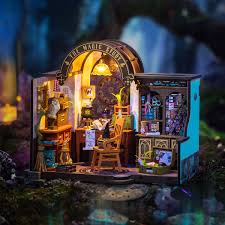
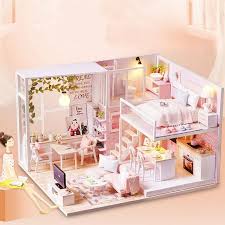
Standing before the kit miniature house , you’ll find yourself unconsciously holding your breath, craning your neck to see every nook and cranny. Why does a tiny room, just a few centimeters across, evoke such a powerful sense of immersion? The answer lies not in proportion or materials, but in the psychology behind the details —those tiny, meticulously restored details that allow us to complete the story in our minds, generating a powerful emotional resonance.
1. Tiny details activate the brain’s imagination
Psychological research has found that the human brain is highly sensitive to cues . When you see an open book, a half-drawn curtain, or a piece of paper gently dropped on the corner of a table in a
kit miniature house , your brain automatically creates a context for the surroundings. You imagine: What did the owner just leave for? From which direction did the sunlight enter the room? Is there the aroma of coffee in the air?
This “imagination” experience makes kit miniature houses more captivating than photographs. You’re not just observing a still life; you’re participating in the life of a miniature world.

2. The charm of realistic proportions and subtle differences
Realism isn’t just about a 1:12 scale; it’s also about subtle variations in proportion .
For example, a piece of paper on the windowsill is slightly wider than the tabletop, or a doorknob is slightly higher than ideal. These subtle imperfections actually make a space feel more real.
Our brains are accustomed to perfectly proportioned photos, but life is never perfect. The subtle variations in a kit miniature house are like a breath of life, giving the viewer a sense of familiarity rather than a cold, impersonal model.
3. Resonance of Color, Light and Shadow with Emotion
In psychology, there’s a concept called “emotion-triggering colors.” Warm tones make people feel comfortable and safe, while cool tones can trigger contemplation or loneliness.
Every light and color choice in the kit miniature house silently conveys emotion:
The kitchen under the warm yellow light brings warmth and memories;
The cool blue light of the study inspires a sense of quietude, reflection, and immersion.
The viewer’s emotions are drawn to details, often as small as a few millimeters, yet they can have a huge psychological impact.
4. Texture and Tactile Cues
Even if you can’t touch, your eyes perceive the “tactile feel” of materials. Wood grain, fabric texture, and the subtle roughness of the wall all activate tactile associations in the brain.
This psychological phenomenon illustrates how realistic kit miniature houses not only stimulate the eye but also create a false sense of spatial reality.
This is also why, with the same size and proportions, improperly handled materials can feel artificial and lack engagement.

5. Storytelling immerses the brain
Details activate imagination, materials convey reality, light and shadow control emotions, but what ultimately fascinates people is the sense of story .
Every small object has a reason to exist:
A half-open envelope suggests that news has just been received;
The lifted sheets looked as if someone had just left;
The coffee cup on the table emanates a lingering aroma.
The viewer connects the dots between the details, creating a psychological sense of immersion.
This is why the more realistic the kit miniature house, the more captivating it becomes: it’s not about viewing an object, but about experiencing a condensed moment of life .
6. Conclusion: The beauty of details lies not in quantity but in significance
truly captivating kit miniature house isn’t a collection of countless small pieces, but rather one where every detail is thoughtfully considered, serving to create a story and emotion.
Psychology tells us that the brain automatically seeks clues and fills in the blanks, and these clues you provide in
a kit miniature house are the magic that guides the viewer’s immersion. Therefore, attention to detail isn’t just about meticulous craftsmanship; it’s about giving the space a sense of breath, a story, and warmth.
https://www.dguilty.com/the-ultimate-guide-to-crafting-hyper-realistic-kit-miniature-houses/