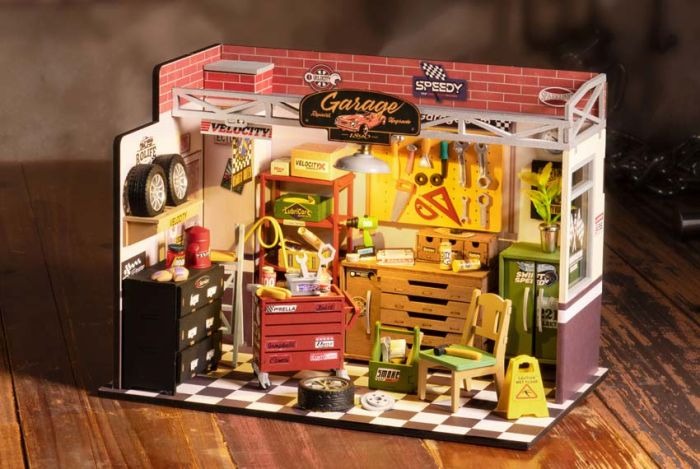
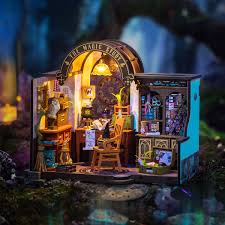
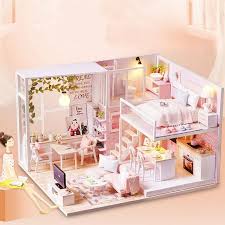
https://www.dguilty.com/the-ultimate-guide-to-kit-miniature-houses-construction-scale-and-crafting-mastery/
1. Proportion is the first “unspoken rule” of kit miniature house
build kit miniature houses have experienced this: everything assembles perfectly, but once the furniture is added, the whole scene falls apart.
Chairs are too high, doors are too low, tabletops are out of proportion—the problem often lies not in craftsmanship but in proportion. Proportion determines the work’s realism and whether the viewer can be immediately convinced of this miniature world.
Proportion isn’t a math problem; it’s a visual language. 1:12 and 1:24, seemingly just a fraction of a point, are like the difference between fiction and poetry—the former meticulously depicts the textures of life, while the latter emphasizes abstraction and white space. Mastering proportion means learning to tell a story through scale.
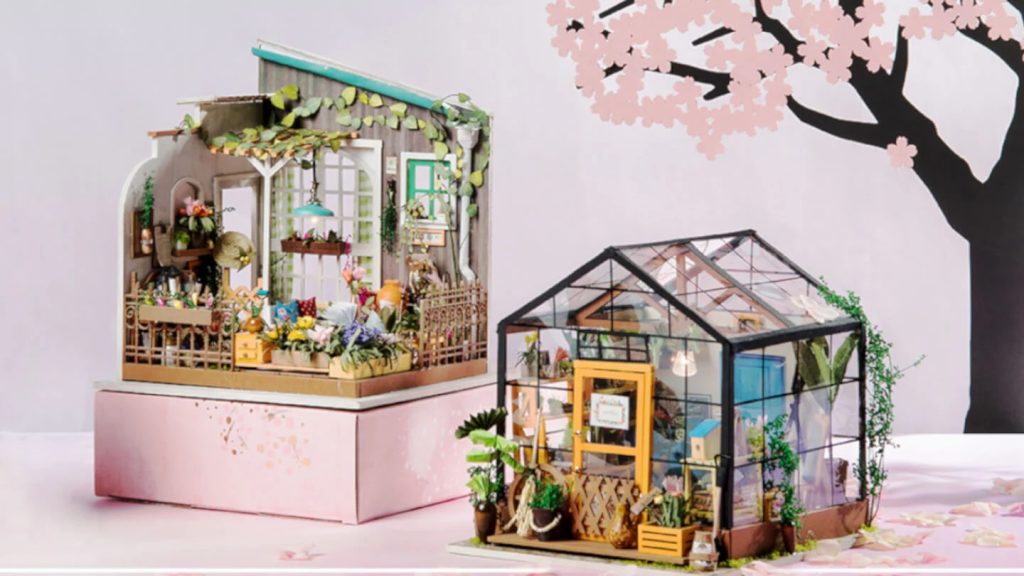
2. 1:12 ratio: the ultimate restoration of life
1:12 is called the “golden ratio” because it best reflects reality. In reality, one meter becomes 8.3 centimeters. This scale allows you to see every detail of life clearly.
Its advantages are:
There is ample space for details such as furniture, lamps, and fabrics to truly present the texture of life;
The lighting arrangement is more natural and suitable for shooting;
The ready-made materials and parts are the most complete, making it easy for beginners to get started.
For example, if you’re designing a small kitchen, a 1:12 scale model can make pot lids open and close, miniature bowls reflect light, and even small wall hooks have logic. It’s more than just a work of art; it feels like a real space suspended in time.
But this comes at a cost—it takes up space. A medium-sized 1:12 scale model of a small room would almost feel like a self-contained display on a desk. If your goal is to collect or carry it for display, it might feel cumbersome.
1:24 ratio: lighter, but more demanding
The 1:24 scale kit miniature house is instantly appealing: compact, exquisite, and space-saving. However, constructing it is far more challenging than one might imagine. When
the space is halved, the error is also magnified. The feeling of “a single shaky hand destroying a wall” often drives beginners crazy.
Its advantage lies in its strong sense of unity. It allows you to depict entire buildings, streetscapes, or courtyards in a smaller volume. When displayed within a glass case, its compactness and layering are even more striking.
However, be aware that this kind of proportion requires compromise in detail. For example, the fabric must be extremely thin, otherwise the proportions will appear “heavy”; the light lines must be extremely thin, otherwise the room will look like it’s being directly illuminated by industrial lighting.
1:24 is a ratio for experienced players, which tests your grasp of structure, light and rhythm – just like a composer writes a melody with a limited number of notes.
4. Three dimensions of consideration for choosing proportions
the
atmosphere of life, furniture details, or atmospheric lighting, choose 1:12.
If you want to depict the overall architecture or urban layout, choose 1:24.
Display Mode:
There is ample space for exhibition, photography and display – 1:12 is more impactful;
for collection, moving or gift giving – 1:24 is light and convenient.
Beginners
start at 1:12, which has a high error tolerance;
experienced players can challenge 1:24, which is more demanding on accuracy and hand steadiness.
Choosing scale is actually choosing your storytelling style. If you want the audience to step into the scene and experience life, enlarge the scale; if you want them to overlook an entire world, reduce the scale.
5. Mixing ratio: Use “visual trap” with caution
Sometimes artists mix scales for effect, such as placing a 1:10 sofa in a 1:12 room. However, this approach often creates an imbalance in the overall composition. Unless one understands the principles of visual perspective, the viewer will perceive a subtle sense of dissonance.
Of course, some experts will deliberately place smaller-scale furniture in the distance to give the space the appearance of depth. This “fake perspective” technique can create a sense of three-dimensionality, but it should be used with extreme restraint.
6. Proportion is a way of thinking
True miniaturists aren’t constrained by scale; they use it to think about reality.
When you begin measuring “miniature versions” of real objects in your mind, you’re not just replicating the world; you’re recreating it. Scale isn’t a constraint; it’s an expression.
1:12 immerses you in detail; 1:24 allows you to see the overall order.
Get the scale right, and the kit miniature house will breathe. Get the wrong scale, and no amount of detail can salvage the sense of realism. Proportion is the quietest, yet most powerful, principle in miniature creation.
https://www.dguilty.com/the-ultimate-guide-to-kit-miniature-houses-construction-scale-and-crafting-mastery/